
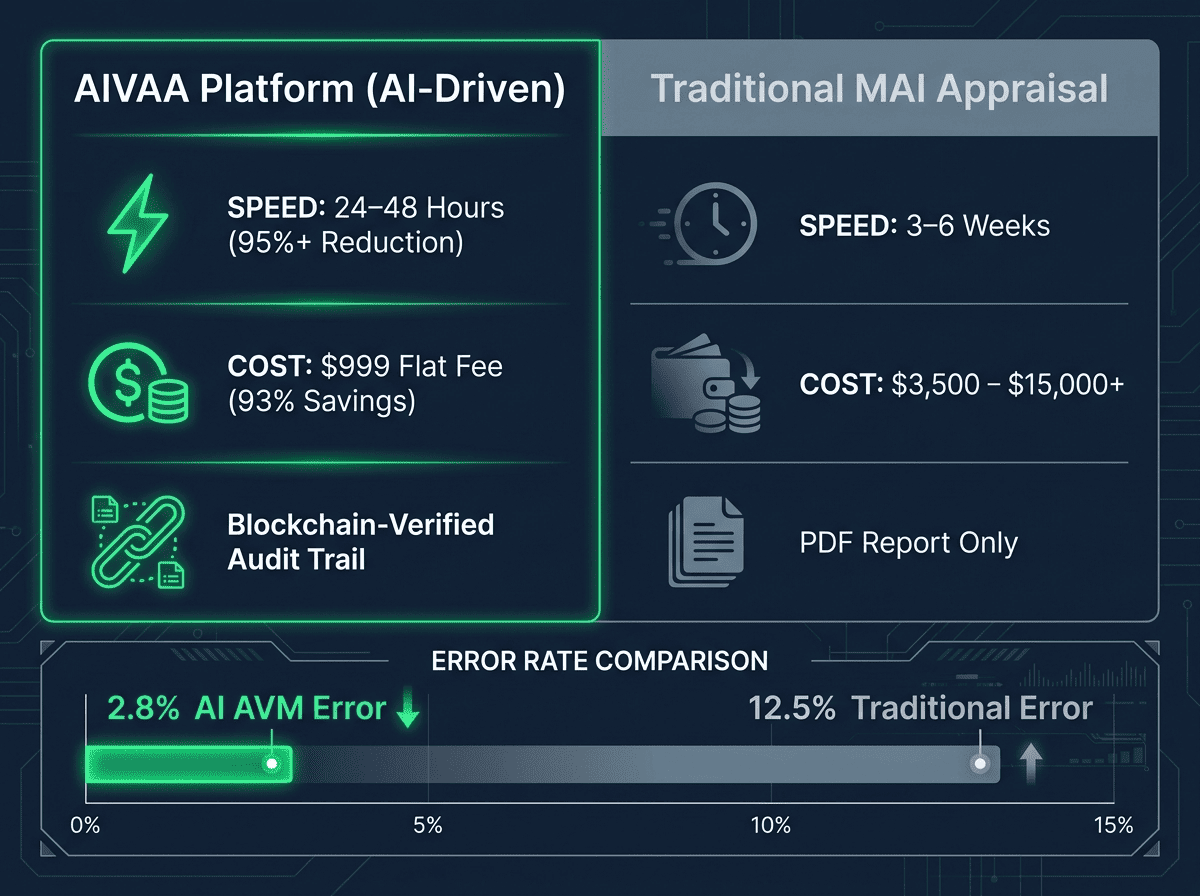
This research paper provides a comprehensive comparative analysis of AIVAA (AI Valuation Agent & Analysis), CR Equity AI’s institutional-grade AI-driven collateral valuation platform, against the traditional MAI (Member of the Appraisal Institute) appraisal standard.
Drawing on CR Equity AI’s proprietary platform documentation, the Dodd-Frank AVM Final Rule (89 FR 64538, effective October 1, 2025), peer-reviewed academic literature on automated valuation models, and industry benchmark data, this paper evaluates AIVAA across four critical dimensions:
- Value proposition
- Regulatory compliance and blockchain infrastructure
- Operational agility and speed
- Industry-average performance benchmarks
Key Findings
The analysis demonstrates that AIVAA delivers valuations in:
- 24–48 hours
- $999 flat fee
This represents:
- Up to 93% cost reduction
- 95%+ time reduction
compared with traditional MAI appraisals.
AIVAA maintains institutional-grade compliance with:
- USPAP Advisory Opinion 41
- SR 11-7
- SR 24-3
- ECOA / Regulation B
- FIRREA Title XI
AI-powered AVM median error rates have declined from 10–15% to approximately 2.8% as of 2026, outperforming the 9–12.5% average absolute deviation documented in traditional appraisal research by Cannon & Cole (2011) and Fisher, Miles & Webb (1999).
The findings position AIVAA as a defensible, scalable, and regulatorily compliant alternative to MAI appraisals for qualifying loan products.
Key Performance Indicators
| Metric | AIVAA | Traditional MAI |
|---|---|---|
| Cost per Valuation | $999 flat fee | $15,000+ |
| Cost Savings | Up to 93% reduction | Baseline |
| Turnaround Time | 24–48 hours | 3–6 weeks |
| AI AVM Median Error (2026) | 2.8% industry average | 9–12.5% academic literature |
| Scalability | Unlimited concurrent orders | Limited by appraiser availability |
| Audit Trail | Blockchain-verified, immutable | PDF report only |
Section 1 — Value Proposition
AIVAA redefines the economics and operational mechanics of collateral valuation by replacing a fragmented, labor-intensive, and time-constrained process with a unified, machine-learning-powered platform that delivers institutional-quality outputs at a fraction of the cost and time.
Traditional MAI Appraisal Process
The traditional MAI appraisal process was designed for a pre-digital era.
A single certified appraiser:
- Physically inspects a property
- Manually researches comparable sales
- Applies subjective judgment to adjustments
- Produces a narrative report
This process typically requires:
| Requirement | Traditional Timeline |
|---|---|
| Standard commercial appraisal | 3–6 weeks |
| Complex assignments | Up to 8 weeks |
| Cost | $3,500–$15,000+ depending on asset complexity and geography |
The U.S. appraisal market carries an estimated annual turnover of approximately $90 billion, a cost ultimately borne by borrowers, lenders, and institutional investors.
AIVAA Technology Foundation
AIVAA disrupts this model through four integrated technological pillars:
1. OCR-Powered Data Ingestion
Extracts structured data from:
- Rent rolls
- Leases
- Property records
2. Real-Time Market Intelligence
Integrates:
- MLS data
- CoStar
- Cap rate indices
- Local comparable sales data
3. Proprietary ML Valuation Engine
A machine-learning valuation engine trained on millions of transactions.
Applies simultaneously:
- Income approach
- Sales comparison approach
- Cost approach
4. Blockchain-Verified Audit Trail
Every valuation is:
- Cryptographically signed
- Immutably logged
- Blockchain verified
Workforce Capacity Challenge
The value proposition extends beyond cost and speed.
The U.S. appraisal workforce has experienced:
| Metric | Data |
|---|---|
| Workforce decline (2021–2026 CAGR) | 4.6% |
| Appraisers aged 51+ | 62% |
| Appraisers under age 36 | 13% |
| Aspiring appraisers unable to find supervisors | Approximately 4,000 |
AIVAA’s unlimited concurrent order capacity eliminates this bottleneck entirely.
“AIVAA delivers comprehensive, defensible property valuations in hours, not weeks — at a fraction of the cost — combining machine learning models, OCR, NLP, and live market data feeds into a single institutional-grade workflow.”
— CR Equity AI, AIVAA Product Overview (2026)
Section 2 — Side-by-Side Comparison Matrix
The following matrix provides a comprehensive, criterion-by-criterion comparison across dimensions relevant to institutional lenders, warehouse partners, and credit committees evaluating AIVAA as a MAI appraisal replacement.
| Evaluation Criterion | AIVAA (CR Equity AI) | Traditional MAI Appraisal |
|---|---|---|
| Turnaround Time | ✅ 24–48 hours (model: 4–8 minutes) | ❌ 3–6 weeks (complex: up to 8 weeks) |
| Cost per Valuation | ✅ $999 flat fee | ❌ $15,000+ |
| Cost Savings | ✅ Up to 93% reduction | Baseline |
| Valuation Methodology | ✅ ML + Income + Sales + Cost simultaneously | Single appraiser judgment; one primary approach |
| Market Data Currency | ✅ Real-time feeds (MLS, CoStar, cap rate indices) | ❌ Point-in-time at physical inspection |
| Scalability | ✅ Unlimited concurrent orders | ❌ Limited by appraiser availability |
| Audit Trail | ✅ Blockchain-verified, cryptographically signed | ❌ PDF report; no chain of custody |
| Consistency | ✅ Model-driven; bias-free methodology | ❌ Appraiser-dependent variability |
| USPAP Alignment | ✅ USPAP-aligned; AO-41 compliant | ✅ USPAP-compliant (when certified) |
| Dodd-Frank AVM Rule | ✅ Full compliance (89 FR 64538, Oct 2025) | N/A — not an AVM product |
| Fair Lending / ECOA | ✅ SHAP explainability; quarterly disparate impact review | Appraiser-dependent; historically documented bias |
| Confidence Scoring | ✅ 0–100 score + FSD% + Hit Rate probability | ❌ No quantified confidence metric |
| Model Governance | ✅ SR 11-7 / SR 24-3 compliant; Model Version Registry | Not applicable |
| Median Absolute Error | ✅ Target ≤6% MdAPE; AI industry average 2.8% | ❌ 9–12.5% average absolute deviation |
| Evaluation Criterion | AIVAA (CR Equity AI) | Traditional MAI Appraisal |
|---|---|---|
| Geographic Bias | ✅ Automated proxy variable screening | ❌ Documented disparities in majority-Black neighborhoods |
| Integration / API | ✅ Full LOS/AUS integration; API-native | ❌ Manual delivery; no API |
| Reconsideration of Value | ✅ Structured ROV process; 5-day resolution | Informal; appraiser discretion |
| Workforce Dependency | ✅ None — fully automated | ❌ High — workforce declining 4.6% CAGR |
Section 3 — Agility & Speed: Redefining the Valuation Timeline
Speed is not merely a convenience metric.
In lending, valuation turnaround time directly impacts:
- Rate lock expiration
- Loan origination velocity
- Portfolio monitoring frequency
- Competitive positioning
AIVAA fundamentally transforms this timeline.
Traditional MAI Appraisal Workflow
A traditional commercial MAI appraisal follows a sequential, labor-intensive workflow.
| Workflow Stage | Timeline |
|---|---|
| Engagement and scheduling | 1–3 business days |
| Research and data collection | 5–10 business days |
| Analysis and report preparation | 5–10 business days |
| Review and delivery | 1–3 business days |
Total timeline:
- Standard commercial assignment: 2–4 weeks
- Complex multi-tenant or special-use properties: 8+ weeks
AIVAA Automated Valuation Workflow
AIVAA collapses the entire workflow into a single automated pipeline.
Process Flow
1. Order Submission
The AIVAA Order Management Console (OMC):
- Assigns a Unique Valuation Order ID (VOID)
- Initiates automated processing
2. Automated Data Collection
Data ingestion occurs from:
- MLS
- Assessor records
- CoreLogic/DataTree
3. Machine Learning Execution
The ML model:
- Completes valuation processing in 4–8 minutes
- Generates confidence scoring
- Produces SHAP explainability output
- Creates blockchain-signed audit trail
4. Final Delivery
Complete valuation reports are delivered within:
24–48 Hours
Operational Impact
A lender processing 100 loans per month using traditional MAI appraisals faces:
- Average pipeline delays of 3–6 weeks per file
With AIVAA:
- The same volume is processed within 24–48 hours per file
- Enables same-week credit decisions
- Reduces rate lock extension costs
Industry estimates place extended lock costs at:
$2,000 per extended lock