
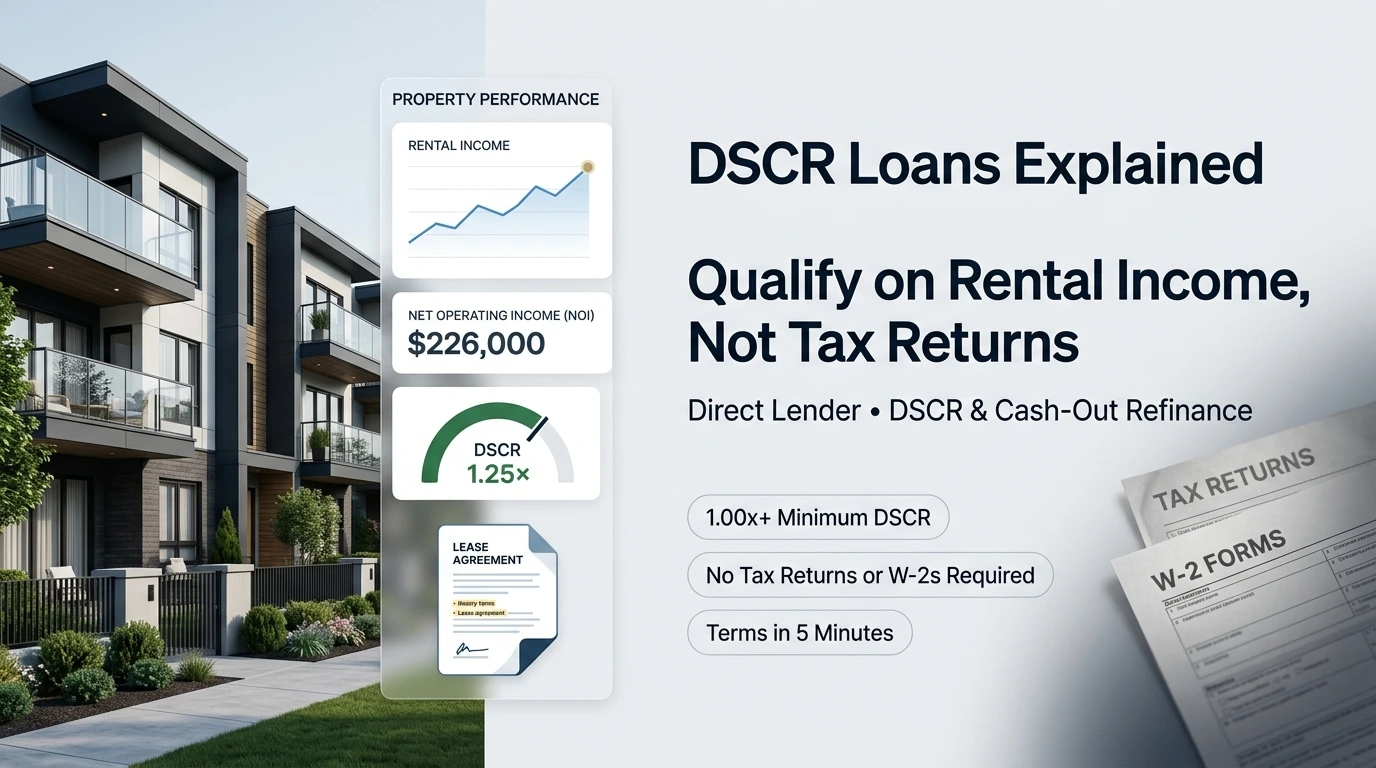
A conventional mortgage asks an investor to prove they can personally afford the loan: tax returns, W-2s, and a debt-to-income calculation that counts every other property against them. That model holds up for a first rental. It falls apart by the third or fourth, and it actively penalizes self-employed investors whose tax returns are built to minimize taxable income rather than showcase it.
A DSCR loan asks a different question. Instead of underwriting the borrower, it underwrites the property, and qualifies the loan against what that property earns. That single change in framing is why DSCR financing has moved from a niche workaround into one of the fastest-growing segments of real estate lending.
This guide covers what the ratio actually measures, why DSCR lending has gone mainstream heading into 2026, the different ways investors use it, who qualifies, and how CR Equity AI prices and funds these loans directly.
What the Ratio Actually Measures
Debt Service Coverage Ratio is simple math: a property’s annual net operating income divided by its annual debt service. A DSCR of 1.00x means the rent exactly covers the mortgage payment. A DSCR of 1.25x means it covers the payment with 25% to spare. Most DSCR programs, including CR Equity AI’s, set a 1.00x floor to qualify.
The detail that matters more than the formula is where the NOI number comes from. A lender that accepts a borrower’s own pro forma is really just underwriting optimism. Sound DSCR underwriting recalculates net operating income independently, from market rent, taxes, and insurance data, so the ratio quoted is the ratio actually funded rather than something revised downward once someone looks closely.
Why DSCR Lending Has Gone Mainstream Heading Into 2026
Three data points explain the shift. Real estate investors accounted for roughly a third of all single-family home purchases in 2025 — the highest investor share of the market in five years, according to BatchData’s Investor Pulse research.
At the same time, non-QM origination volume is forecast to climb to approximately $175 billion in 2026, up from about $108 billion the year before, with DSCR and other investor-focused products expected to make up roughly half of that collateral, according to National Mortgage Professional.
Pricing has stabilized alongside that growth rather than spiking with it. Industry tracking from the National Private Lenders Association shows DSCR rates clustering tightly in the 7–8% range through 2026, with far less dispersion than short-term bridge and rehab pricing. Tight, stable pricing is usually a sign that a lending category has matured past the experimental phase — institutional capital is comfortable enough with the product to stop demanding a volatility premium for it.
For investors, the practical effect of that institutional comfort is a wider credit box: more lenders competing for the same deal, and fewer reasons to accept a rate that assumes DSCR is still a fringe product.
Three Ways Investors Use a DSCR Loan
Buying the Next Rental
A purchase-money DSCR loan qualifies on the deal itself rather than the borrower’s pay stubs. Most programs, CR Equity AI included, will size the loan against a signed lease or even projected market rent on a property that is currently vacant, which matters for anyone buying a rental that needs to be re-tenanted before it cash flows on paper.
Refinancing to Pull Equity or Improve Terms
Investors sitting on equity in a stabilized rental can refinance into a DSCR structure to pull cash out for the next acquisition, replace an expensive bridge or hard money loan with a longer-term structure, or simply reprice a loan now that the lease-up is done and the numbers are proven. The mechanics of CR Equity AI’s cash-out refinance track, including the full advance grid, are covered in a separate guide.
Scaling a Portfolio Past a Handful of Properties
Because DSCR loans are scored per property rather than per borrower, there is no hard cap on how many an investor can hold at once — a real constraint on conventional financing, which caps the number of financed properties and layers each new mortgage’s payment onto the borrower’s personal debt-to-income ratio. That makes DSCR the more scalable structure for anyone building a portfolio of single-family or small multifamily rentals rather than buying one property and stopping.
What It Takes to Qualify
Eligibility centers on the deal, not a personal financial profile:
- A minimum DSCR of 1.00x or higher on the property being financed
- No personal income verification, tax returns, or W-2s required
- Entity and LLC borrowers on business-purpose transactions
- ITIN holders and foreign national investors, generally at somewhat lower leverage unless they can show at least two completed U.S. projects and a qualifying credit score
- Loan sizes commonly running from the mid-five figures up to several million dollars per property, depending on the lender’s program
What falls outside the box is consistent across the industry: owner-occupied primary residences, since DSCR is strictly a business-purpose product, along with property types that don’t produce a stabilized income stream a lender can underwrite, like raw land held speculatively or short-term vacation rentals without an established booking history.
How CR Equity AI Prices and Funds DSCR Loans
CR Equity AI runs DSCR as a direct lender rather than a broker passing files to a committee. Investors get real, quoted terms from an online form in about a minute, with no application fee and no hard credit pull to get there. Files that clear underwriting typically fund in as fast as five days, whether the loan is a purchase, a refinance, or part of a multi-property portfolio.
The underlying pitch is the same one driving the broader market data above: price the loan on the asset’s own performance, verify that performance independently, and let the speed of the decision be a function of automation rather than a loan committee’s calendar.
Key Takeaways
- A DSCR loan qualifies the property’s income, not the borrower’s personal income, tax returns, or W-2s
- Investor purchase activity and non-QM volume are both climbing into 2026, and DSCR pricing has stabilized in the 7–8% range as the category matures
- DSCR loans work for purchases, cash-out refinances, and multi-property portfolios, since each loan is scored per property with no cap on how many an investor can hold
- Vacant properties can often still qualify, based on market rent or a signed lease
- CR Equity AI quotes DSCR terms in about a minute online and funds approved deals in as fast as five days, as a direct lender
Ready to see where a specific deal lands? Get an instant DSCR quote through CR Equity AI’s funding options, or, if the goal is pulling equity out of a property already held, see the cash-out refinance breakdown for the full advance grid and terms.
Sources
1. National Mortgage Professional — DSCR Boom: Why Investor Lending Is Drawing More Attention — https://nationalmortgageprofessional.com/news/dscr-boom-why-investor-lending-drawing-more-attention
2. Lendmire, citing BatchData Investor Pulse Reports — DSCR Loans Explained: 2026 Guide for Investors — https://www.lendmire.com/dscr-loans-guide/
3. National Private Lenders Association — Private Lending Market Report, April 2026 — https://nplaonline.com/blog/npla-private-lending-market-report-april-2026/
4. CR Equity AI — Funding Options — https://crequity.ai/funding