

Real-time credit approvals are automated lending decisions produced in under 200 milliseconds by ingesting live borrower data and applying AI-driven risk models. For commercial real estate investors, business owners, and capital providers, this speed is not a convenience. It is a structural advantage that determines whether a bridge loan closes before a competing bid or a working capital line gets funded before a cash flow gap widens.
The core mechanics involve three simultaneous processes:
- Data ingestion: Credit bureau files, bank transaction data, income verification, and property valuations feed into the engine at the moment of application.
- Risk scoring: Machine learning models calculate a probability of default, factoring in behavioral signals and alternative data sources beyond the traditional FICO score.
- Policy enforcement: A rules layer applies regulatory constraints, portfolio limits, and fraud flags before the final decision is committed.
The result is a decision pipeline that processes thousands of applications per hour with consistent quality and sub-second latency, a capability that legacy manual underwriting cannot replicate.
Table of Contents
- How static and real-time credit models differ
- How AI and machine learning transform credit underwriting
- Real-world applications in commercial real estate and small business financing
- What CR Equity Ai Inc’s platform delivers
- Common challenges in implementing real-time credit approvals
- Regulatory and compliance considerations in AI-driven credit decisions
- How real-time approvals change the borrower and lender experience
- Measurable outcomes from real-time credit approval deployments
- Future trends in real-time credit approval technology
- CR Equity Ai Inc: faster capital decisions for serious borrowers
- Key Takeaways
How static and real-time credit models differ
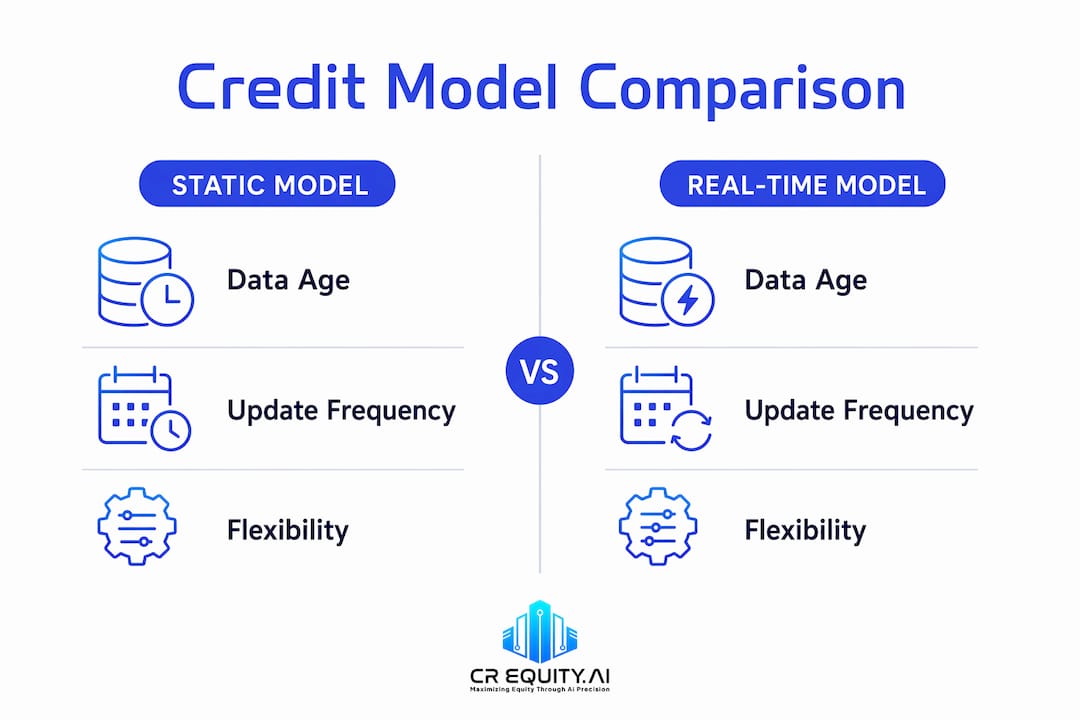
Traditional static models assign a credit score at a point in time and apply it uniformly to every subsequent transaction. Real-time models evaluate each application against current exposure, transaction velocity, and a freshly scored risk profile.
| Dimension | Static model | Real-time model |
|---|---|---|
| Data recency | Weeks to months old | Live, updated at decision time |
| Risk sensitivity | Fixed score thresholds | Dynamic, behavior-adjusted scoring |
| Responsiveness | Batch processing | Sub-second decision commitment |
| Fraud detection | Rule-based pattern matching | Sequential behavioral analysis |
The practical gap shows up when two borrowers look identical on paper. A sequential foundation model reads the order and timing of a full transaction history rather than reducing it to a single score. One borrower recovers after an overdraft on the next paycheck. The other drains the account within 24 hours of each paycheck, fills the gap with small transfers, and repeats the cycle. A static model sees the same numbers. A real-time model sees two different borrowers.
Key advantages of real-time decisioning over static approaches:
- Detects nuanced behavioral risk patterns invisible to fixed scorecards.
- Captures current cash flow and liquidity, not a six-month-old snapshot.
- Identifies fraud sequences that bypass static rule sets.
- Adjusts credit limits proactively based on live financial health signals.
How AI and machine learning transform credit underwriting
AI-powered underwriting processes far more data per applicant than traditional models ever could. Contemporary systems evaluate thousands of data points per applicant, compared to fewer than 35 in traditional credit scoring, according to research on real-time decision architecture. That expanded data universe has enabled measurable improvement in default prediction accuracy across consumer lending portfolios.
Sequential foundation models take this further by reading the order and timing of transactions, not just their aggregate totals. In early tests, one such model cut default risk by 13.6% at a 70% approval rate and reduced losses from returned payments by 26.5%. Those figures reflect what happens when a model distinguishes transient financial stress from chronic behavioral patterns.
The operational benefits for lenders are direct. Behavior-based AI models improve four key issuer metrics simultaneously: approval rates rise, false declines fall, operating costs drop as fewer transactions require human review, and fraud losses decrease because criminals who bypass fixed rules still leave traces in the transaction sequence.
CR Equity Ai Inc embeds these AI capabilities into its underwriting platform, combining machine learning risk scoring with automated document intelligence and real-time lender matching to deliver decisions that reflect current borrower conditions, not historical averages.
Real-world applications in commercial real estate and small business financing
Real-time credit decisioning changes the economics of commercial lending by compressing timelines that once took days into processes that complete in minutes. For bridge loan originations, acquisition financing, and working capital facilities, speed directly affects deal viability.

Real-time decisioning platforms ingest live data streams to flag risk patterns, initiate early warnings, and adapt credit limits proactively across the full credit lifecycle, from origination through collections, demonstrating how Cómo se evalúa la solvencia crediticia en México integrates real-time data to evaluate borrower eligibility and limit default risk in real estate. That lifecycle coverage matters in commercial real estate, where a borrower’s financial position can shift materially between application and closing.
Practical applications include:
- Bridge and construction loans: Rapid credit evaluation against current property valuations and borrower liquidity, reducing time-to-close.
- Acquisition financing: Automated DSCR analysis and risk scoring against live income verification data.
- Working capital lines: Dynamic credit limit management based on real-time cash flow signals rather than annual reviews.
- Fraud prevention: Rolling transaction windows track velocity and exposure to catch card-testing and concurrent authorization abuse before losses occur.
Pro Tip: For commercial real estate borrowers, real-time platforms that integrate automated valuation models (AVMs) alongside credit scoring can deliver a combined property and borrower risk assessment in a single decision pass, eliminating the sequential delays of traditional underwriting.
What CR Equity Ai Inc’s platform delivers
CR Equity Ai Inc is built specifically for the commercial real estate and business financing market, where deal complexity and capital volume demand institutional-grade accuracy at consumer-grade speed. The platform covers the full credit lifecycle through a set of integrated capabilities.
Core platform features:
- AI-based underwriting with machine learning risk scoring across credit bureau, transactional, and alternative data sources.
- Automated document intelligence for income verification, property data, and KYC/AML compliance.
- Real-time lender matching that surfaces multiple loan offers within minutes of application submission.
- Automated compliance monitoring aligned with regulatory requirements.
- Cloud-native infrastructure supporting concurrent transaction loads without decision coherence failures.
| Platform capability | Borrower benefit | Lender benefit |
|---|---|---|
| AI risk scoring | Faster decisions, fewer document requests | Higher-quality pre-underwritten deal flow |
| Multi-offer matching | Competitive terms from multiple capital sources | Access to pre-screened borrower profiles |
| Automated KYC/AML | Reduced friction at application | Compliance coverage without manual review |
| Document automation | Faster closing timelines | Lower per-loan processing cost |
CR Equity Ai Inc supports commercial real estate loan products including self-storage acquisition and development loans, bridge financing, construction loans, business term loans, and asset-based credit lines. Borrowers receive multiple offers in minutes. Lenders gain access to pre-underwritten opportunities that arrive with AI-enhanced credit models already applied.
Common challenges in implementing real-time credit approvals
The technical demands of real-time decisioning are significant. The most common failure point is not latency but decision coherence. When exposure, velocity, and risk scores are served from three independent pipelines, concurrent transactions can each commit against a composite that no coherent snapshot ever produced. A unified serving layer that holds all three signals under one logical snapshot is the architectural fix, but building it requires substantial engineering investment.
Data integration presents a parallel challenge. Modern decisioning engines integrate an average of 18.7 distinct data sources per decision. Connecting credit bureaus, payroll databases, bank transaction feeds, and property valuation services into a single real-time pipeline requires API-first infrastructure that many legacy lenders do not have. Established institutions updating older systems face a more difficult transition than digital-native lenders that started on modern architecture.
Model governance adds another layer of complexity. AI models require continuous validation to ensure they remain accurate as borrower behavior and market conditions shift. Without ongoing monitoring, a model trained on pre-recession data can produce systematically biased decisions in a changed environment.
Regulatory and compliance considerations in AI-driven credit decisions
AI-driven credit decisions operate within a defined regulatory framework. The Equal Credit Opportunity Act (ECOA) and the Fair Housing Act require that adverse action notices identify specific reasons for denial, a requirement that applies equally to automated and manual decisions. When an AI model declines an application, the system must produce an explainable output that satisfies this legal standard.
The Fair Credit Reporting Act (FCRA) governs how alternative data sources, including cash flow transactions, utility payments, and behavioral signals, can be used in credit decisions. Lenders incorporating non-traditional data must confirm that each source qualifies as FCRA-regulated before using it in a decisioning model.
Model risk management guidance from federal banking regulators requires that institutions validate AI models before deployment and monitor them on an ongoing basis. For commercial real estate lenders, this means maintaining documentation of model inputs, outputs, and performance metrics that can withstand regulatory examination. CR Equity Ai Inc addresses these requirements through automated KYC/AML, digital verification, and audit-ready decision records built into its cloud-native infrastructure.
How real-time approvals change the borrower and lender experience
For borrowers, the shift from days-long underwriting to near-instant decisions removes the uncertainty that historically made commercial financing difficult to plan around. Multiple offers arriving within minutes allow borrowers to compare terms in context rather than accepting the first approval out of time pressure.
For lenders, the operational impact is equally direct. Fewer transactions require human review, which reduces per-loan processing cost and allows underwriting teams to focus on complex cases rather than routine approvals. Real-time dashboards provide continuous visibility into approval rates, risk segmentation, and portfolio performance, replacing the lagging indicators that batch processing produced.
The borrower experience improvement also has a retention dimension. AI agents that trigger adaptive verification rather than flat declines, adjusting limits or stepping up identity checks instead of blocking legitimate transactions, preserve customer relationships that static rule sets would have severed.
Measurable outcomes from real-time credit approval deployments
The performance data from real-time credit deployments is specific. At Deutsche Bank, credit reviews that once took days now run in near real time, with clients no longer waiting weeks for a decision, according to Chief Risk Officer Marcus Chromik in a McKinsey report cited by PYMNTS.
Research on real-time decision architecture shows that 79.8% of consumer credit applications now receive decisions in under 3 seconds, compared to an industry average of 36 hours in 2015. Each 10-millisecond reduction in decision latency correlates with a measurable increase in approval rates and a reduction in false positives.
For commercial real estate specifically, faster credit decisions translate into faster closings. Borrowers who can present a pre-underwritten credit package to sellers and title companies hold a negotiating advantage that manual underwriting cannot replicate. The AI underwriting revolution in commercial real estate is producing exactly this outcome: compressed timelines that shift deal dynamics in favor of prepared, technology-enabled borrowers.
Future trends in real-time credit approval technology
Agentic credit is the next architectural shift. Rather than evaluating a borrower once at origination and applying the same rules to every subsequent transaction, agentic systems evaluate each transaction individually against current cash flow, existing obligations, and real-time behavioral signals. Affirm President Libor Michalek described this to PYMNTS as taking into account what a transaction translates to on a per-month obligation and how that relates to the borrower’s current cash flow and existing debt.
Embedded credit is advancing in parallel. Billtrust’s Agentic Credit Lines product, launched in March 2026, embeds credit limit recommendations directly into the software finance teams use to track receivables, drawing on data from 13 million business buyers and 25 years of B2B payment history. The direction is clear: credit decisions are moving from standalone applications to embedded, continuous evaluation within the tools borrowers already use.
For commercial real estate, the next frontier is property-level decisioning that combines automated valuation, borrower credit scoring, and market condition data into a single real-time output. Platforms that integrate these signals under one coherent architecture will define the standard for AI-driven commercial lending over the next several years.
CR Equity Ai Inc: faster capital decisions for serious borrowers
Commercial real estate investors and business owners who have experienced the friction of traditional underwriting know the cost: deals lost to slower competitors, capital gaps that compound, and weeks spent assembling documentation for decisions that could have been made in minutes.
CR Equity Ai Inc delivers what traditional lenders cannot: AI-driven underwriting, automated document processing, and real-time lender matching combined in one platform built for commercial-scale transactions. Borrowers receive multiple loan offers in minutes, not weeks. Lenders access pre-underwritten deal flow with AI-enhanced credit models already applied. The platform covers bridge loans, acquisition financing, construction loans, working capital facilities, and asset-based credit lines, with automated KYC/AML and compliance monitoring built in. Whether you are evaluating your investor credit options or ready to receive a loan quote, CR Equity Ai Inc gives you the speed and accuracy that commercial financing now demands. Start with a loan quote to see what AI-driven underwriting delivers for your specific deal.
Key Takeaways
Real-time credit approvals give commercial real estate investors and business owners a structural advantage by delivering AI-scored, multi-offer decisions in minutes rather than weeks.
| Point | Details |
|---|---|
| Decision speed | Credit decisioning engines produce lending decisions in under 200 milliseconds by combining bureau data, AI scoring, and policy rules. |
| Static vs. real-time | Real-time models read transaction sequences and current cash flow; static models apply a fixed score regardless of current borrower behavior. |
| AI performance gains | Sequential AI models have shown meaningful improvements in reducing default risk and returned payment losses in early tests. |
| Compliance requirements | ECOA, FCRA, and model risk management guidance apply fully to AI-driven decisions, requiring explainable outputs and ongoing model validation. |
| CR Equity Ai Inc | The platform delivers AI underwriting, real-time lender matching, and automated compliance for commercial real estate and business financing in one integrated system. |