
Executive Summary
The AI-Driven Transformation of Real Estate Brokerage
The real estate brokerage profession is undergoing its most consequential structural transformation in a century.
Agentic artificial intelligence — systems capable of autonomous, multi-step reasoning and action — has moved from theoretical possibility to operational reality, compressing timelines that once took weeks into hours, commoditizing tasks that once justified premium commissions, and enabling an entirely new class of fintech platforms to displace the traditional brick-and-mortar brokerage model.
CR Equity AI: Accelerating the Shift Toward Intelligent Transaction Infrastructure
Against this backdrop, fintech platforms like CR Equity AI are not merely augmenting the traditional brokerage model — they are replacing its most capital-intensive functions.
| Traditional Process | CR Equity AI Capability | Impact |
|---|---|---|
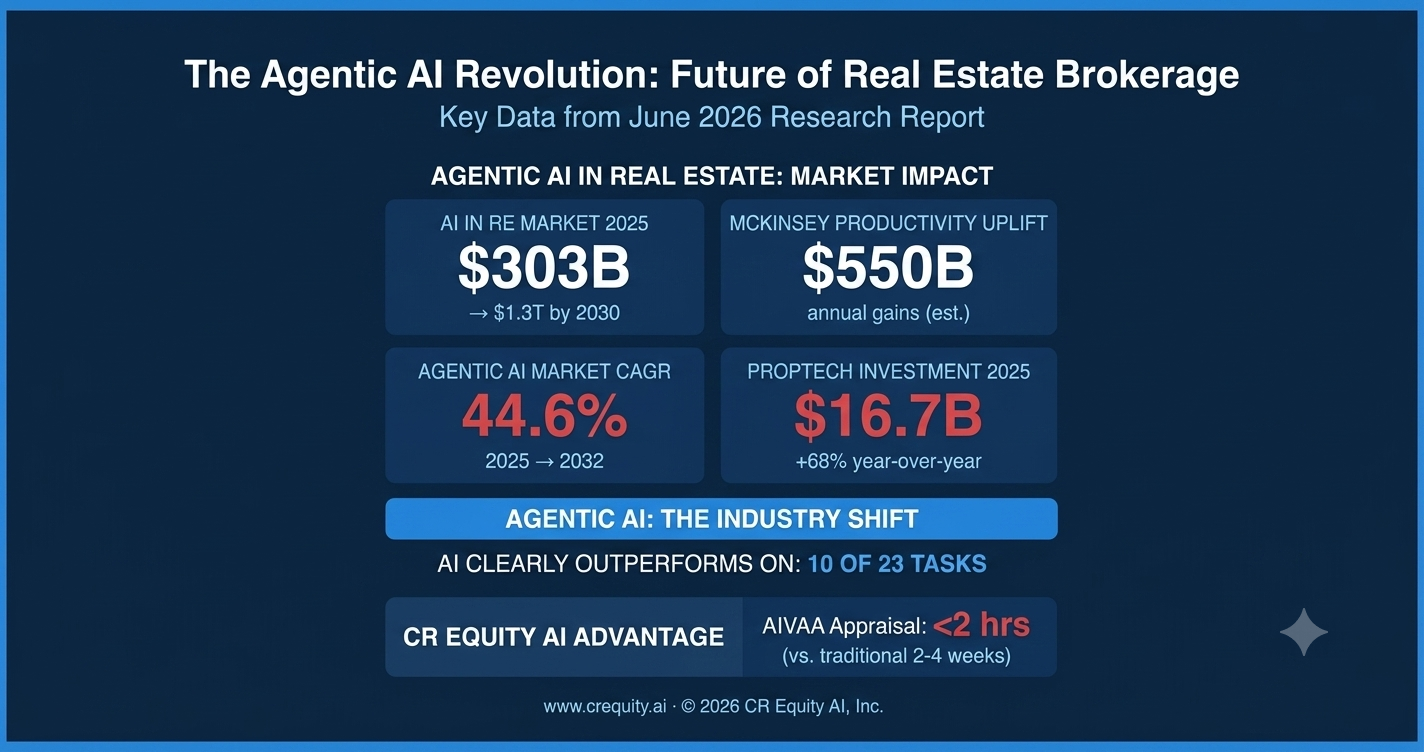
| Commercial property valuation | AIVAA valuation engine | Produces MAI-grade commercial property appraisals in under two hours |
| Traditional appraisal process | Automated valuation workflow | Replaces a process that traditionally cost $4,346 and took two to four weeks |
| Loan underwriting | Automated underwriting system | Delivers loan decisions in four hours versus the industry standard of 30 to 90 days |
This report provides a comprehensive analysis of agentic AI’s impact on the real estate brokerage profession, structured around three forecast horizons:
| Forecast Horizon | Period |
|---|---|
| 12 Months | 2026–2027 |
| 3 Years | 2028–2029 |
| 5 Years | 2030–2031 |
It examines how platforms like CR Equity AI are accelerating the structural shift away from relationship-dependent, office-anchored brokerage toward intelligent, cloud-native, data-driven transaction infrastructure.
1. Defining Agentic AI in the Real Estate Context
Agentic AI represents a qualitative leap beyond the generative AI tools that first captured industry attention in 2022 and 2023.
Where generative AI answers questions and drafts content, agentic AI acts — it pursues goals, adapts to changing circumstances, coordinates across multiple systems, and executes multi-step workflows without continuous human direction.
Agentic AI in Real Estate
In the real estate context, an agentic system does not merely draft a listing description or summarize a market report.
It can:
- Capture a lead
- Analyze the buyer’s behavioral and financial signals
- Recommend properties
- Schedule tours
- Adjust pricing suggestions
- Prepare documentation
- Flag compliance requirements
- Escalate negotiation moments to a human agent
All within a single orchestrated, autonomous flow.
Why This Matters
The distinction matters enormously for the brokerage profession.
First-generation AI tools threatened to make individual tasks faster and cheaper.
Agentic AI threatens to make entire workflows — from lead generation through closing — executable without a licensed human intermediary at every step.
2. The Current State of AI Adoption in Real Estate
Widespread Adoption, Limited Automation
As of mid-2026, AI adoption in real estate is best characterized as widespread but shallow — broad in its reach across the industry, but still concentrated in augmentation rather than replacement.
PwC’s Emerging Trends in Real Estate 2026 report captures the current moment: job replacement is occurring but remains rare among real estate firms; job transformation and use-case exploration are more prevalent at this stage.
AI Adoption Indicators
| Metric | Data |
|---|---|
| Real estate investors piloting AI tools | 88% |
| Companies planning to increase AI spending over the next three years | 92% |
| Enterprise applications expected to embed task-specific AI agents by end of 2026 | 40% |
| AI-centered PropTech growth in 2025 | 42% annualized |
| Non-AI PropTech growth in 2025 | 24% |
The data supports this nuanced picture.
Zillow launched its AI Mode in March 2026, Redfin introduced its AI strategy in February 2026, and Realtor.com deployed AI features in October 2025 — all three major portals went AI simultaneously.
Yet McKinsey’s January 2025 Superagency report found that only 1% of companies describe themselves as mature in AI deployment, even as 92% plan to increase AI spending over the next three years.
The wave is building; it has not yet crashed.
Investor Market Reaction
The February 2026 AI scare trade crystallized investor anxiety about this trajectory.
| Company | Stock Impact |
|---|---|
| CBRE | Declined more than 20% |
| JLL | Declined 14% |
| Cushman & Wakefield | Declined 13% |
| Colliers | Declined 11% |
The market was not reacting to current weakness — it was repricing future disruption risk, recognizing that the business models of large, labor-intensive advisory firms are structurally vulnerable to AI-native challengers whose marginal cost of analysis approaches zero.
3. Task-Level Disruption: What AI Can and Cannot Do
The most rigorous task-level analysis comes from the June 2026 Alloy Advisors report authored by industry veterans Amit Kulkarni and Russ Cofano.
Their framework — examining 23 distinct tasks performed during a home sale — provides the clearest empirical basis for understanding where AI creates genuine disruption and where human judgment retains irreplaceable value.
Tier 1: Tasks AI Has Commoditized
AI now performs:
- Comparative market analyses
- MLS data entry
- Listing descriptions
- Offer modeling
- Transaction coordination
- Basic disclosure checks
with greater speed, consistency, and lower cost than human agents.
The pre-AI market value for this work was roughly:
$1,500–$3,500 per listing
Today, the marginal cost for a competent AI user is close to zero.
Operational Evidence
| Activity | Traditional Timeline | AI Timeline |
|---|---|---|
| Site selection | Months | Days |
| Due diligence | Weeks | Hours |
| Underwriting | Days | Minutes |
Additional results:
- Home builders using AI agents for lead response have seen response times improve by more than 90%.
- Rental organizations using AI-driven renewal workflows have improved renewal rates by 3% to 7%.
Tier 2: Tasks Requiring Human Judgment
Three tasks retain a clear, durable human advantage:
1. Negotiation Execution
Negotiation execution remains stubbornly human.
A skilled agent acting as an active negotiator and buffer provides real, measurable value — and the Alloy Advisors report does not see this changing in the near term.
2. Hyperlocal Tacit Knowledge
The instinct for:
- Which street floods
- Which HOA is a headache
- Why one cul-de-sac commands a premium
lives in experience, not in any public dataset an AI can scrape.
3. Emotional Support and Crisis Management
Real estate transactions are often among the most stressful financial decisions in a person’s life.
Supporting clients through:
- Failed inspections
- Financing scares
- Complex transaction challenges
represents human work that AI cannot replicate with the trust and empathy required.
AI Impact Timeline
The CloudDon AI Agentification Index assigns Real Estate Brokers a score of:
32.1 / 100
Category: Mid-to-long-term agentification
Expected timeline: Five or more years before significant automation impact.
The critical insight:
AI does not replace agents; it replaces average agents and rewards excellent ones.
4. The Commission Model Under Siege
The Traditional Real Estate Commission Structure
The traditional real estate commission structure — a percentage-based fee bundled into a single, undifferentiated charge regardless of agent skill or transaction complexity — is facing its most serious structural challenge in the industry’s history.
Transaction Cost Breakdown
| Category | Amount |
|---|---|
| Typical home sale price | $400,000 |
| Total hard transaction costs | $39,660 |
| Real estate commissions | $23,000 |
| Commission percentage | 5.75% |
| Share of seller-paid friction | 76% |
Why Commission Compression Has Been Limited
The National Association of Realtors’ $418 million settlement, whose practice changes took effect in August 2024, was expected to compress commissions.
It largely did not — the national average commission actually rose to 5.44% in mid-2025.
Three structural factors explain this stickiness:
1. Seller-Paid Buyer Commissions
Seller-paid buyer commissions never truly disappeared in practice.
2. Limited A La Carte Brokerage Services
Thirteen states plus Washington, D.C. effectively ban a la carte brokerage services.
3. Bundled Pricing Structure
The all-or-nothing contingent-fee structure discourages itemized pricing that consumers can comparison-shop.
AI-Informed Consumer Pressure
The Alloy Advisors conclusion is that regulation alone was never going to move the number — but AI-informed consumers represent a fundamentally different kind of pressure.
When a seller can ask an AI to:
- Evaluate every line item
- Model alternatives
- Benchmark a quoted commission in real time