
Most RV park deals fit one of three lanes: SBA 7(a) or 504 for stabilized, long-term real estate; a conventional bank first-lien for straightforward acquisitions with strong financials; or bridge and seller financing when speed matters more than rate. The right choice depends on how fast you need to close, how stabilized the park’s income already is, and how much equity you’re putting in. Everything below maps those factors to the right product.
TL;DR:
- Loans for RV parks vary based on the speed of closing needed, park stabilization, and the amount of equity a borrower can provide.
- SBA 504 is ideal for long-term real estate purchases, with fixed rates on major infrastructure, but requires extensive documentation and a strong income history.
- Bridge and seller financing offer rapid closing options suitable for non-stabilized parks, but typically come with higher costs and shorter repayment periods.
- Conventional bank loans are best for well-established parks with strong financials, often involving balloon payments after five or ten years.
- Borrowers should verify lender LTV grids upfront, prepare detailed financials and site reports, and consider staging their financing to minimize costs and risks.
Table of Contents
- RV Park Loan Options: What Each One Does and When to Use It
- How Do You Choose the Right RV Park Loan?
- What Do Lenders Look for in an RV Park Loan Application?
- What Does an RV Park Loan Cost, and How Long Does It Take?
- What Underwriters Actually Look For
- Fast, Transparent Financing for RV Park Projects
- Where to Verify Lenders and Program Details
- Sources
- FAQ
RV Park Loan Options: What Each One Does and When to Use It
Every RV park loan falls into a handful of categories, and each one solves a different problem. Matching the product to the job, not just the lowest rate, is what keeps a deal on schedule.
SBA 7(a) is the flexible workhorse. It covers acquisition, working capital, equipment, and even refinancing existing debt under one umbrella. The trade-off is documentation: expect to submit tax returns, a business plan, and detailed projections, and expect the process to run longer than a conventional loan because SBA underwriting layers federal guidelines on top of the lender’s own review.
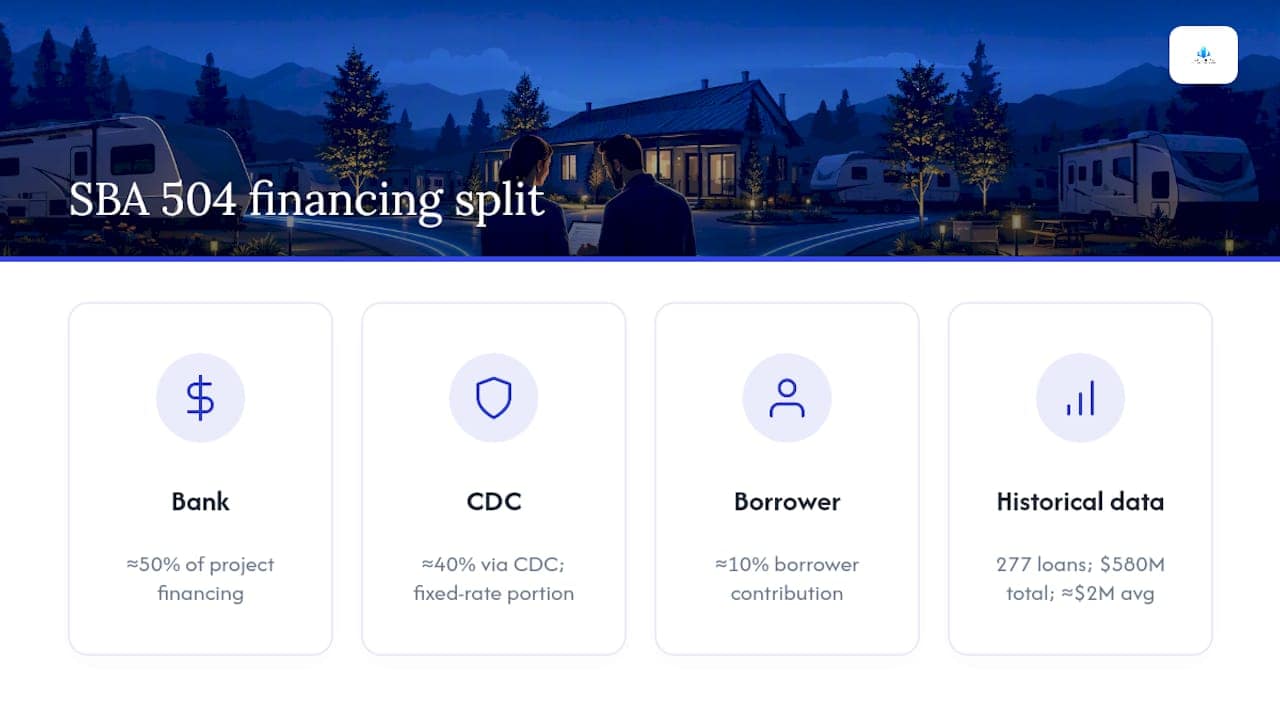
SBA 504 is built specifically for real estate and long-term fixed assets, which makes it a natural fit for RV parks buying land, buildings, or major infrastructure. The structure splits financing three ways: roughly 50% from a bank, 40% from a Certified Development Company (CDC), and a 10% borrower contribution, according to historical SBA 504 data for the RV park sector, which tracked 277 loans totaling about $580 million over ten years, averaging near $2 million per deal. The CDC portion carries a fixed rate for the life of the loan, which shields borrowers from rate swings on long-term debt.
Conventional bank loans work well for buyers with clean financials and an established park. Community banks are often more willing to underwrite hospitality-adjacent real estate than larger institutions, but many still structure these loans with a balloon payment after five or ten years rather than a full 25 or 30-year amortization.
Bridge and hard-money loans exist for speed. Direct bridge lenders underwrite RV parks based on potential stabilized revenue rather than trailing financials alone, and they can move to a term sheet in as little as 24 hours with closings in days rather than months. The trade-off is cost and a shorter runway. Most bridge loans are interest-only and expect a refinance or sale within one to three years.
Seller financing shifts negotiating leverage to the deal itself. A motivated seller carrying part of the note can unlock a purchase that a bank wouldn’t touch quickly. It also materially lowers the capital a first-time buyer needs at closing, according to industry guides on RV park financing.
USDA Business & Industry (B&I) loans apply only to parks in eligible rural areas, so check USDA property maps before assuming eligibility. When a park qualifies, B&I terms can rival SBA on rate and term length.
Lines of credit and equipment loans round out the picture. Seasonal parks often need a credit line to cover payroll and maintenance during the off-season, and equipment loans finance items like mowers, golf carts, and utility infrastructure without tying up real estate collateral.

How Do You Choose the Right RV Park Loan?
Four factors decide the answer: how fast you need to close, how the funds will be used, how much equity you’re bringing, and how much documentation you can produce on short notice.
- Need to close fast, or buying in the off-season? Bridge financing or seller carry lets you move before a competing buyer does, without waiting on a full SBA underwriting cycle.
- Buying stabilized real estate for the long term? SBA 504 or a conventional first-lien gives you fixed, long-term financing once the park has a documented income history.
- Need working capital or mixed-use funds (acquisition plus equipment plus a cash cushion)? SBA 7(a) or a business line of credit covers multiple needs under one facility.
- Buying a park that isn’t stabilized yet? Plan a two-step exit: close on bridge or seller financing now, then refinance into permanent debt once occupancy and revenue stabilize.
Before signing a term sheet, ask every lender the same set of questions: How long from application to close? What’s the advance rate or loan-to-value (LTV) on this specific asset type? What reserves are required at closing? Will you need a full appraisal, environmental study, or utility report, and who pays for it? Are there third-party fees beyond origination?
Pro Tip: Ask for the lender’s advance-rate grid in writing before you apply. A lender who won’t show you the LTV structure up front is one of the clearest red flags in RV park financing, along with unusually short time-to-term-sheet promises that come with no documentation requirements at all.
What Do Lenders Look for in an RV Park Loan Application?
Lenders evaluate the park’s income first, and the borrower’s paperwork second. Debt Service Coverage Ratio (DSCR), which measures net operating income against annual debt payments, sits at the center of nearly every underwriting decision. For seasonal parks, underwriters normalize revenue across the full year rather than judging the deal on peak-season months alone, since a park’s annual cash flow, not just July occupancy, determines whether it can service debt.
Expect to assemble:
- Two to three years of business financial statements and tax returns
- A pro forma with realistic occupancy and rate assumptions
- Current booking and occupancy data, plus a rent roll or site revenue summary
- Site plans and entitlements for any ground-up or expansion component
- Environmental and utility reports where the lender requires them
SBA 504 and 7(a) both carry an owner-occupancy expectation, meaning the borrower’s operating business must occupy and run the property rather than lease it out entirely to a third party.
Operators without a long track record can still strengthen a package. Sponsor experience in hospitality or real estate, a larger equity contribution, third-party validation of pro forma assumptions, and a signed letter of intent with a management company all reduce a lender’s perceived risk. A direct lender that publishes its advance-rate grid before you apply and relies on a soft credit pull rather than full income verification can also shorten the surprises that typically surface at term sheet.
What Does an RV Park Loan Cost, and How Long Does It Take?
Timelines vary sharply by product. Bridge loans can close in days to a few weeks. SBA and conventional bank loans generally take several weeks to a few months due to additional processing and reporting requirements.
Budget for these costs regardless of loan type:
- Down payment or equity contribution (often 10% to 25%+ depending on structure)
- Origination and underwriting fees
- Appraisal and environmental or site studies
- Title work and standard closing costs
A common staging playbook works like this: close fast with bridge or seller financing, complete site improvements that raise average daily rate and occupancy, document 12 to 24 months of stabilized revenue, then refinance into SBA 504 or conventional permanent debt at a lower carrying cost, following the staging approach bridge lenders describe for park acquisitions. Plan your reserves around that full window, not just the initial close.
What Underwriters Actually Look For
Every deal I’ve reviewed lives or dies on three things: a credible pro forma, a clearly scoped improvement budget, and conservative occupancy assumptions. Borrowers who pad revenue projections to hit a target DSCR slow their own approval, because underwriters strip those assumptions back out and re-run the numbers anyway.
Published advance-rate grids matter more than most borrowers realize. When a lender shows its LTV tiers before you apply, it removes the single biggest source of term-sheet surprises: a rate or advance rate that shifts after underwriting has already started. The most common borrower mistake I see isn’t weak credit. It’s missing site or environmental reports that should have been ordered on day one, which pushes a 45-day close into a 90-day close for no good reason.
— Robert
Fast, Transparent Financing for RV Park Projects
A direct private lending platform offers lending directly without brokering deals to other lenders. That distinction matters because you’re negotiating with the capital source itself, on advance-rate grids published before you apply, with decisions in as little as four hours on qualifying files.

Our programs map cleanly onto the RV park financing paths covered above. Need to move fast on an acquisition or beat a seller’s deadline? Our F.L.E.X. 50™ emergency bridge program funds in 24 to 48 hours. Planning ground-up development or major site improvements? Our construction loans draw on our own capital through milestone-based disbursements instead of a third-party warehouse line. Once your park has stabilized income and you’re ready to refinance out of short-term debt, our DSCR cash-out refinance qualifies on rent and revenue rather than tax returns, which helps self-employed and 1099 sponsors who don’t fit a conventional bank box. We also support ITIN and foreign national investors alongside U.S. borrowers on eligible programs.
If you have an RV park deal in acquisition, development, or refinance, submit it for review and get a direct read on structure and terms rather than a broker’s guess.
Where to Verify Lenders and Program Details
Before signing with any lender, confirm licensing through NMLS Consumer Access and check bank oversight through the FDIC. For SBA eligibility specifics, review SBA loan guidance for RV parks and campgrounds directly.
Sources
- SBA Loan for RV Park | SBA 504 RV Park Financing
- RV Park Financing Options: SBA Loans, Seller Finance & Creative Deals | RV Park World
- Federal Deposit Insurance Corporation (FDIC)
FAQ
Can You Get a Loan to Buy an RV Park?
Yes. Common paths include SBA 7(a) and 504, conventional bank first-liens, bridge or hard-money loans, seller financing, and USDA B&I loans for eligible rural properties, with the right choice depending on timeline and stabilization.
How Much Is a Monthly Payment on a $100,000 RV?
That depends on the loan term, interest rate, and down payment, since RV consumer loans are structured differently from commercial RV park financing and typically amortize over about 10 years; check a specific lender’s amortization schedule for an exact figure.
What Is the Monthly Payment on a $50,000 Business Loan?
The payment depends heavily on term length and rate, since a short-term bridge facility and a long-term SBA loan on the same principal amount produce very different monthly figures; request an amortization schedule from the specific lender before comparing offers.
Is It Profitable to Own an RV Park?
Profitability depends on occupancy, rate management, and debt structure, but lenders underwrite RV parks by normalizing revenue across the full year rather than peak season alone, which reflects how seasonal cash flow actually supports debt service over time.